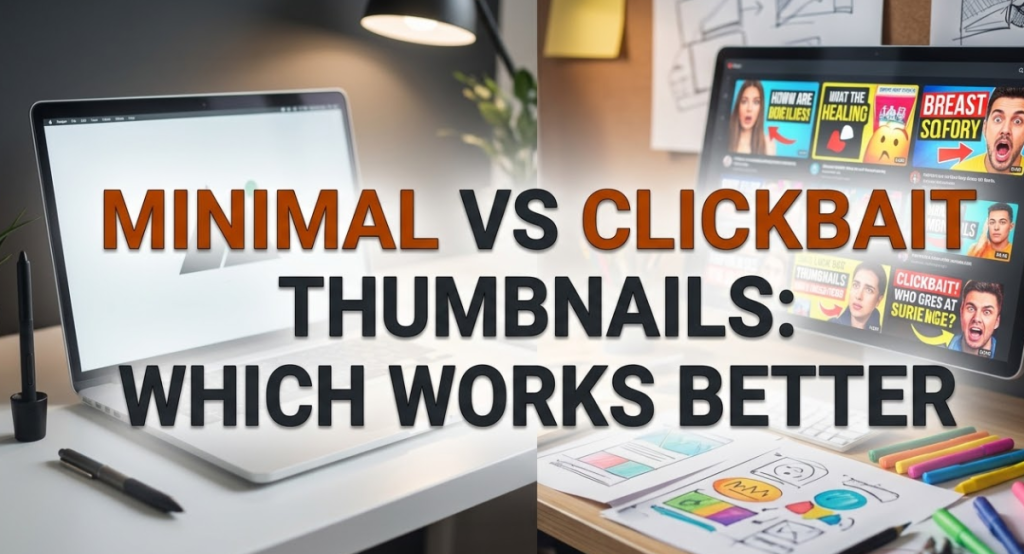
You can make the best video in the world. But if no one clicks on it, it doesn't matter.
That's why the debate around minimal vs clickbait thumbnails matters so much right now. Your thumbnail is the first thing a viewer sees. It decides whether they click — or scroll past without a second thought.
Some creators go bold. Huge faces. All-caps text. Shock expressions. Others keep it clean, simple, and honest. Both styles exist for a reason. Both can work — or completely backfire.
So which one actually performs better? That's what we're going to break down in this guide. We'll look at the data, the psychology, the risks, and the best approach for your specific goals.
Let's get into it.
What Are Minimal Thumbnails?
Minimal thumbnails focus on simplicity. They use clean design, limited text, and a clear visual message.
Think of a thumbnail with one person, a simple background, and maybe two to four words of text. No clutter. No noise. Just one clear idea that matches the video content.
Key traits of minimal thumbnails:
- Simple color palette (usually two or three colors)
- Short, readable text
- Clean fonts
- Honest preview of the video
- Calm, professional look
Channels like Kurzgesagt, CGP Grey, and many successful documentary-style creators use this approach. Their thumbnails feel trustworthy, on-brand, and easy to understand at a glance.
Minimal thumbnails work well when your audience values expertise and trust over hype.
What Are Clickbait Thumbnails?
Clickbait thumbnails are designed to grab attention fast — even if that means exaggerating or misleading the viewer.
They usually feature extreme expressions, dramatic text, red arrows, circles around random things, or shocking images that may not even relate to the video content.
Key traits of clickbait thumbnails:
- Exaggerated facial expressions
- Bright, contrasting colors (often red, yellow, and orange)
- Lots of text, usually in all-caps
- Shock factor or mystery
- A sense of urgency ("You won't believe this!")
YouTube channels in the gaming, entertainment, and prank space often rely heavily on this style. MrBeast popularized the extreme facial expression trend. Many creators followed suit.
Clickbait thumbnails can drive fast clicks — but they come with a cost.
The Psychology Behind the Click
To understand the minimal vs clickbait thumbnail debate, you first need to understand how people actually make decisions when scrolling.
Viewers spend less than two seconds deciding whether to click on a video. Their brains are pattern-matching constantly.
Here's what triggers a click:
Curiosity — If something looks interesting or surprising, people want to know more.
Trust — If someone recognizes your channel, they're more likely to click even without dramatic elements.
Relevance — If the thumbnail clearly matches what someone is searching for, they'll click.
Emotion — Faces trigger emotional responses. A shocked face grabs attention. A calm, confident face builds authority.
Clickbait exploits curiosity and emotion in the short term. Minimal thumbnails build trust and relevance over time. Both tap into real psychological triggers — just in different ways.
Minimal vs Clickbait Thumbnails: A Side-by-Side Comparison
| Factor | Minimal Thumbnails | Clickbait Thumbnails |
|---|---|---|
| Click-Through Rate (CTR) | Moderate to High (over time) | High (initially) |
| Audience Retention | High | Low to Moderate |
| Trust Building | Strong | Weak |
| Brand Identity | Consistent | Often inconsistent |
| Long-Term Channel Growth | Sustainable | Can plateau |
| Risk of Viewer Disappointment | Low | High |
| Algorithmic Favor | Strong long-term | Short-term spike |
| Works Best For | Educational, niche, personal brand | Entertainment, viral content |
Click-Through Rate: Who Wins in the Short Run?
Let's talk numbers.
Click-through rate (CTR) measures how many people click your thumbnail after seeing it. YouTube considers a healthy CTR to be anywhere from 2% to 10%. Top-performing videos can go higher.
Clickbait thumbnails often win this battle — in the beginning.
A shocking image or exaggerated expression triggers an automatic reflex. People click before they think. This bumps up the CTR fast, and YouTube's algorithm notices.
But here's what the data also shows: if viewers click and don't like what they find, they leave quickly. YouTube tracks this as poor audience retention. And when retention drops, the algorithm pulls back on recommending that video.
Minimal thumbnails might start with a lower CTR. But they tend to attract viewers who actually want the content. Those viewers watch longer, engage more, and come back for future videos.
In the minimal vs clickbait thumbnail race, clickbait wins the sprint. Minimal wins the marathon.
Audience Retention: The Metric That Matters Most
YouTube's algorithm doesn't just care about clicks. It cares about what happens after the click.
Audience retention — how much of your video viewers watch — is one of the most important signals YouTube uses to decide who sees your content.
Clickbait thumbnails create a mismatch. The thumbnail promises something exciting. The video delivers something different. Viewers feel tricked. They leave. YouTube sees this as a bad experience and stops pushing the video.
This is sometimes called the "thumbnail-content gap." It's one of the biggest mistakes new creators make.
Minimal thumbnails, on the other hand, set accurate expectations. Viewers know roughly what they're getting. When the content delivers, they stay. Some even hit subscribe.
According to various creator analytics case studies, videos with honest, minimal thumbnails consistently outperform clickbait in watch time — even when they have a lower initial CTR.
How YouTube's Algorithm Treats Each Style
YouTube's recommendation system is smarter than most people think.
It doesn't just promote videos with lots of clicks. It promotes videos where people click and stay and come back. It looks at:
- Click-through rate
- Average view duration
- Watch percentage
- Shares and comments
- Subscriber gain after watching
Clickbait can spike CTR but damages the other metrics. YouTube eventually deprioritizes these videos.
Minimal thumbnails that match content can build a feedback loop of positive signals. Every happy viewer feeds the algorithm something good.
Over time, channels with minimal thumbnails often see steadier, more sustainable growth — even if the early numbers look slower.
If you want to design better thumbnails that balance both style and strategy, tools like Canvix.io can help you create professional thumbnails with precision and speed.
Does Niche Matter? Matching Your Style to Your Audience
Not every niche responds the same way to thumbnails.
Niches where minimal thumbnails perform better:
- Personal finance and investing
- Health and wellness
- Educational content and tutorials
- Cooking and recipes
- Tech reviews and software guides
- Career development and productivity
Niches where clickbait-style thumbnails still hold up:
- Gaming (especially reaction and let's play content)
- Entertainment and pop culture commentary
- Vlogs and challenge videos
- Prank and reaction channels
- Sports highlights
The reason is simple: audience expectations differ. Someone searching for "how to invest for beginners" wants a credible, calm guide. Someone watching gaming commentary is okay with hype and energy.
Understanding your audience's expectations before you design your thumbnail is one of the most underrated steps in content strategy.
The Trust Problem with Clickbait
Let's talk about something that doesn't show up in analytics dashboards: trust.
When viewers feel tricked by a thumbnail, they don't just leave the video. They lose faith in your channel. They may never come back. And they might even leave a dislike or a negative comment.
Over time, this creates a real brand problem.
Viewers who discover your channel through honest thumbnails are far more likely to:
- Subscribe
- Watch multiple videos
- Share your content
- Come back the next time you post
Clickbait might bring strangers. Honest thumbnails bring fans.
According to a study by Google and Ipsos, trust is one of the most powerful drivers of consumer behavior online. When a thumbnail feels deceptive, even once, it affects how a viewer sees all future content from that channel.
That trust cost is invisible in your CTR graph — but it's very real.
Can You Mix Both Styles? The Hybrid Approach
Here's the good news: you don't have to pick a side.
Many successful creators use what could be called a "strategic hybrid." They make thumbnails that are visually bold and attention-grabbing — but still honest about the content.
Think of it as clickbait that actually delivers.
How to do it:
- Use bright colors and strong contrast — but keep them on-brand
- Add one or two words of compelling text — but don't overpromise
- Use expressive but natural facial expressions — not forced shock
- Include a clear visual reference to what's actually in the video
- Stay consistent with your channel's visual identity
This approach can give you the CTR boost of clickbait without the retention crash. It's the sweet spot most growing creators aim for.
A/B Testing: How to Know What Works for Your Channel
No guide can tell you exactly what works for YOUR audience. That's why testing matters.
YouTube Studio now lets you test thumbnails on the same video. It shows different thumbnails to different viewers and tracks which one gets more clicks and better retention.
Simple thumbnail A/B testing steps:
- Upload your video with Thumbnail A
- Wait 48–72 hours and note the CTR and retention
- Switch to Thumbnail B and track the same metrics
- Pick the winner and stick with it
You can also test across multiple videos over time. Look for patterns. Which colors, text lengths, or image styles consistently outperform?
Data from your own channel is always more valuable than any general advice.
Common Mistakes to Avoid With Both Styles
Whether you lean minimal or clickbait-style, there are some universal thumbnail mistakes that hurt performance.
With minimal thumbnails:
- Text too small to read on mobile
- Background too plain — blends into YouTube's interface
- No contrast between subject and background
- Forgetting to show a human face when relevant
With clickbait thumbnails:
- Promising something the video doesn't deliver
- Overloading with text — viewers scan in under two seconds
- Using the same shocked face on every video (viewers stop noticing)
- Creating false urgency that feels fake
Both styles suffer from:
- Poor image quality or blurry visuals
- Too many elements competing for attention
- Inconsistent branding across videos
- Ignoring how the thumbnail looks at small mobile sizes
Always preview your thumbnail at thumbnail size — not full screen. Most viewers will see it at 120×90 pixels or smaller.
Frequently Asked Questions (FAQs)
Q1: Do minimal vs clickbait thumbnails affect YouTube SEO?
Yes, indirectly. YouTube doesn't read the visual content of thumbnails directly. But thumbnails affect CTR and retention, which are two of the strongest signals in YouTube's ranking algorithm. Better thumbnails mean better performance, which means better rankings.
Q2: Which thumbnail style grows a channel faster?
Clickbait thumbnails can grow a channel faster in the short term. But minimal thumbnails tend to build a more loyal, engaged audience. For sustainable long-term growth, most creators find honest thumbnails outperform clickbait over time.
Q3: Is clickbait against YouTube's rules?
YouTube has a policy against "misleading thumbnails" that promise content the video doesn't deliver. Violating this repeatedly can lead to video removal or strikes. However, many clickbait thumbnails stay in a gray area. The risk isn't just policy — it's also viewer trust and retention.
Q4: How often should I change my thumbnail style?
Don't change styles too often. Consistency helps viewers recognize your brand. If you want to experiment, try small changes — different color schemes, text placement, or image choice — while keeping the overall look familiar.
Q5: Do thumbnails matter more than titles?
Both matter. Thumbnails trigger the initial attention. Titles confirm what the video is about. The best strategy is to make them work together — your thumbnail grabs the eye, your title closes the deal.
Q6: What thumbnail size does YouTube recommend?
YouTube recommends 1280×720 pixels with a 16:9 aspect ratio and a file size under 2MB. JPG, GIF, BMP, or PNG formats all work. Designing at this resolution keeps your thumbnail sharp across all devices.
Q7: Can small channels use minimal thumbnails and still grow?
Absolutely. In fact, starting with a consistent minimal style can help a small channel build brand recognition faster. Viewers start to recognize your thumbnails in a feed, even before reading the title. That familiarity builds trust early.
The Verdict: What Actually Works Better?
After looking at CTR data, retention metrics, algorithm behavior, and viewer psychology — here's the honest answer:
There is no one-size-fits-all winner.
Clickbait thumbnails can generate fast results in high-energy niches where viewers expect hype. But they carry real risks: low retention, audience distrust, and algorithm punishment over time.
Minimal thumbnails build slower but build better. They attract the right viewers, keep them watching, and create a loyal audience that grows steadily.
The best creators understand both approaches. They design thumbnails that are visually compelling and emotionally engaging — without misleading anyone. Bold but honest. Exciting but accurate.
In the minimal vs clickbait thumbnail debate, the real winner is whoever best understands their audience, tests their designs, and stays consistent with their brand.
That's the strategy that holds up — whether the algorithm changes tomorrow or five years from now.
Start designing smarter thumbnails today. Your click-through rate will thank you.
